
Museum of history and archaeology in Palma
Museum of Mallorca
A public museum in a town-palace in Palma’s old town devoted to the archaeology, history, art and decorative arts of the island. Opening hours, prices and what to see.
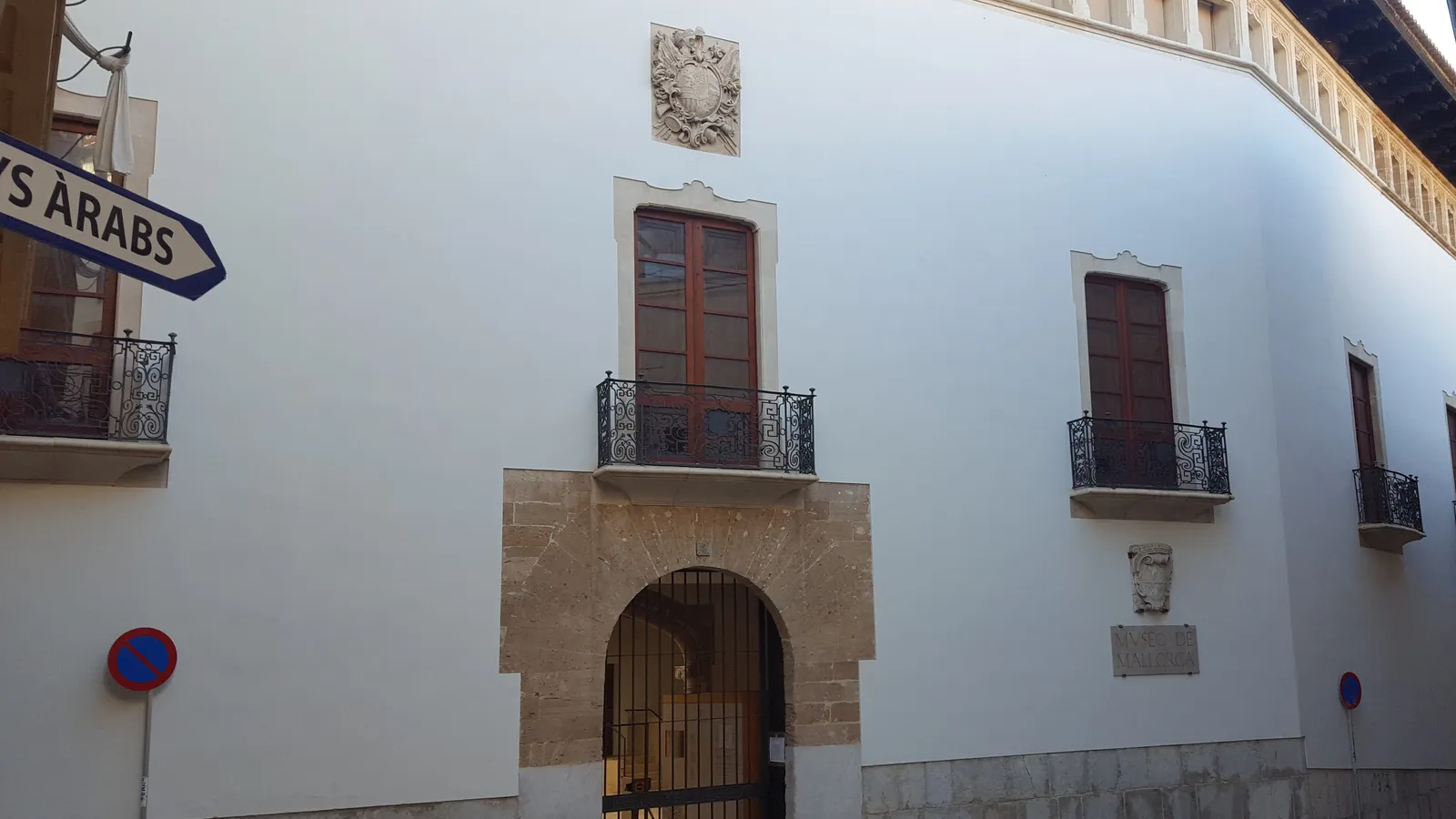
Practical information
- Opening hours
- Wednesday: 09:00–19:00; Saturday: 09:00–14:00
- Prices
- General admission: €2.40
- Visit length
- A visit to the Museum of Mallorca usually lasts 60 to 90 minutes.
- Location
- Carrer de la Portella, 5, 07001 Palma de Mallorca, Illes Balears
- Booking
- Booking is usually not needed for an ordinary individual visit. Groups, educational visits and special activities may require arranging the visit in advance.
The Museum of Mallorca is a public institution dedicated to preserving, studying and sharing the history and cultural heritage of the island. Its main site is the Casa de la Gran Cristiana, a 16th-century town palace on Carrer de la Portella, in Palma’s old town.
Please note: free Sunday access and reduced rates may be subject to change. Check the current conditions before you travel.
Opening hours of the Museum of Mallorca
The most recent institutional information published by the Consell de Mallorca gives this schedule for the Palma site:
| Day | Hours |
|---|---|
| Tuesday | 09:00–14:00 |
| Wednesday | 09:00–19:00 |
| Thursday | 09:00–19:00 |
| Friday | 09:00–14:00 |
| Saturday | 09:00–14:00 |
| Sunday | 09:00–14:00 |
| Monday | Closed |
Official tourist information also reflects this calendar and notes the usual closure of the site on Mondays and official public holidays.
Best day to visit
Wednesday or Thursday are the most convenient days for anyone who prefers to visit the museum in the afternoon, as it stays open until 19:00.
If you visit Palma at the weekend, keep in mind that opening hours end at 14:00.
Closures and changes
Opening hours can vary because of:
- Public holidays.
- Exhibition installation.
- Conservation work.
- Cultural events.
- Organisational changes.
- Temporary restrictions in some rooms.
It is advisable to check the official page or contact the museum before going, especially if you are travelling on holiday dates.
Ticket prices
The general price published for the Palma site is €2.40.
| Ticket type | Guide price |
|---|---|
| General admission | €2.40 |
| Reduced admission | €1.20 |
| Free admission | Depending on the group and conditions |
| Sundays | Free, according to published tourist information |
The reduced rate may apply to students and holders of the Carnet Jove, although it is best to confirm the conditions and required documentation at the time of the visit.
Is it free on Sundays?
Yes, the available tourist information indicates that entry is free on Sundays.
Free Sunday access and reduced rates may be subject to change. Check the current conditions before you travel.
Who can get in free?
- Minors.
- People over 65.
- Unemployed people.
- Teachers.
- Official guides.
- Museum professionals.
- Members of certain cultural associations.
- Visitors during special cultural events.
The required documentation depends on the specific case. It is important to bring the corresponding proof.
Visitor experiences
Reviews
Loading reviews…
Frequently asked questions
What is the Museum of Mallorca?
It is a public museum devoted to the archaeology, history, art and decorative arts of Mallorca. Its main site is a 16th-century town-palace in Palma.
Where is the Museum of Mallorca?
It is at number 5, Carrer de la Portella, in Palma’s old town, near the Cathedral and the Royal Palace of La Almudaina.
How much does it cost to enter the Museum of Mallorca?
General admission costs €2.40 and reduced admission €1.20, according to the official tourist information available.
Is the Museum of Mallorca free on Sundays?
The published tourist information indicates that entry is free on Sundays. It is advisable to confirm this before the visit because rates can change.
What are the opening hours of the Museum of Mallorca?
It opens on Tuesdays, Fridays, Saturdays and Sundays from 09:00 to 14:00. On Wednesdays and Thursdays it opens from 09:00 to 19:00. On Mondays it is closed.
How long does the visit to the Museum of Mallorca take?
A normal visit lasts between one hour and an hour and a half. A detailed visit can extend to two hours.
Do I need to book to visit the museum?
Booking is usually not needed for individual visitors. Groups, schools and participants in special activities may need to book in advance.
What can be seen at the Museum of Mallorca?
The collection includes prehistoric archaeology, Roman pieces, Islamic art, medieval painting and sculpture, decorative arts and works linked to Mallorca’s artistic history.
Is the Museum of Mallorca worth visiting?
Yes, especially to understand the history of the island and to see a heritage collection in a historic building in the centre of Palma.
Does the museum have several sites?
Yes. Besides the main site in Palma, there is an ethnological section in Muro and the Museu Monogràfic de Pollentia in Alcúdia.
What other places can be visited nearby?
Mallorca Cathedral, the Royal Palace of La Almudaina, the Arab Baths, Parc de la Mar, Palma’s city walls and the Bishop’s Palace.
How to get there
The official address is:Carrer de la Portella, 507001 Palma de Mallorca, Illes Balears
The museum is in the historic quarter of Palma, near the city wall, the Cathedral, the Royal Palace of La Almudaina and the Arab Baths.
On foot, from some central tourist spots it takes roughly:
- Mallorca Cathedral: 5 minutes.
- Royal Palace of La Almudaina: 5–10 minutes.
- Parc de la Mar: 5 minutes.
- Plaça de Cort: 10–15 minutes.
- Plaça d’Espanya: 20–25 minutes.
These times are approximate and depend on the exact starting point.
Palma’s centre has various nearby bus lines. The stops around Porta del Camp, Plaça de la Reina and Plaça de Cort let you reach the museum from other parts of the city. For specific line numbers it is best to check them on Palma’s transport website, as they can change.
The museum was founded in 1961 and is co-managed by the State, the Govern de les Illes Balears and the Consell de Mallorca. Its route combines archaeology, art, history and decorative arts, with a special focus on pieces linked to Mallorca.
It is not only a painting museum. Above all, it is a place to understand the island’s evolution through its archaeological remains, religious objects, works of art, documents and everyday items.
What is the Museum of Mallorca?
The Museum of Mallorca is a public institution dedicated to preserving, studying and sharing the history and cultural heritage of the island. Its main site is the Casa de la Gran Cristiana, a 16th-century town palace on Carrer de la Portella, in Palma’s old town. The building was formed from several old houses and keeps the atmosphere of a Mallorcan manor house.
The museum was founded in 1961 and is co-managed by the State, the Govern de les Illes Balears and the Consell de Mallorca. Its route combines archaeology, art, history and decorative arts, with a special focus on pieces linked to Mallorca.
What to see at the Museum of Mallorca
The collection is organised to show different stages of Mallorcan history. The exact layout of the rooms can vary because of conservation work, loans or exhibition changes.
Prehistory and archaeology
The archaeology section helps you understand the cultures that inhabited Mallorca before the Romans arrived. The route can include material related to the first prehistoric communities, the Talayotic culture, indigenous settlements, the Punic and Mediterranean presence, the Roman period, Islamic Mallorca and the Christian conquest.
These pieces show how housing, religion, economy, pottery, tools and burial practices changed over the centuries.
Roman Mallorca
Romanisation transformed the island profoundly. The museum keeps objects that help explain urban organisation, commercial activity and domestic life during the Roman period. The material includes pottery, architectural elements, everyday objects, decorative pieces and remains linked to the old Mallorcan cities.
To go deeper into the Roman period, you should also visit the Museu Monogràfic de Pollentia in Alcúdia, one of the Museum of Mallorca’s satellite sites.
Medieval art
Medieval art is one of the most important parts of the museum. The collection includes works linked to Mallorca’s Christian tradition and to the island’s artistic development after the 1229 conquest. Visitors can find Gothic painting, medieval sculpture, altarpieces, religious imagery, liturgical art, objects linked to worship and decorative arts.
This section is especially interesting for anyone who wants to understand Palma’s importance as an artistic and commercial centre of the Mediterranean during the Middle Ages.
Painting and sculpture
The museum keeps works that trace the evolution of art in Mallorca from the late Middle Ages to the modern and contemporary centuries. The route can show the transition between Gothic painting, the Renaissance, the Baroque, academism and later trends. The selection on display can change, so it is best to check the current programme.
Decorative arts
The decorative arts show aspects of domestic, religious and social life in Mallorca. This section can include furniture, pottery, everyday objects, gold and silversmith pieces, textiles, religious decoration and objects linked to manor houses.
It is useful for anyone who wants to learn not only about the great artists, but also about how the island’s different societies lived and what objects they used.
The Casa de la Gran Cristiana
The building deserves special attention. The museum’s site keeps the character of a town-palace in Palma’s old town and adds historical value to the visit. The tour lets you see the structure of an old manor house, patios and distribution spaces, traditional architectural elements and different construction phases.
The museum is interesting precisely because the pieces are not in an isolated modern room, but inside a building with its own history.
The three sites of the Museum of Mallorca
The Museum of Mallorca has one main site and two satellite sites.
| Site | Town | Main content |
|---|---|---|
| Museum of Mallorca | Palma | Archaeology, fine arts, decorative arts, bibliographic and documentary holdings |
| Ethnological Section | Muro | Objects and materials linked to traditional Mallorca and everyday life |
| Museu Monogràfic de Pollentia | Alcúdia | Roman archaeology linked to the ancient city of Pollentia |
The Palma site is the most suitable for a first visit to the institution. Muro and Alcúdia work as complements for anyone who wants to go deeper into Mallorcan ethnology or the island’s Roman past.
Do I need to book?
Booking is usually not needed for an ordinary individual visit. Groups, educational visits and special activities may require arranging the visit in advance.
- Organised groups.
- Schools.
- Guided tours.
- Family activities.
- Researchers.
- Enquiries about documentary holdings.
- Temporary exhibitions with limited capacity.
The museum’s official page should be the reference for bookings, arranged visits and special activities.
Booking is not needed for an ordinary individual visit. Groups, educational visits and special activities may require arranging the visit in advance.
How long does the visit take?
A visit to the Museum of Mallorca usually lasts 60 to 90 minutes.
| Visit type | Recommended time |
|---|---|
| Quick visit | 45–60 minutes |
| Normal visit | 60–90 minutes |
| Detailed visit | 90–120 minutes |
| Museum plus old town | 2–3 hours |
An hour can be enough for an overview. If you want to read the panels, linger over the medieval pieces and look at the building, it is better to allow an hour and a half.
For a cultural route through Palma, a practical combination would be the Museum of Mallorca, the Arab Baths, Mallorca Cathedral, the Royal Palace of La Almudaina and Parc de la Mar.
Is the Museum of Mallorca worth visiting?
Yes, especially for anyone who wants to know Mallorca beyond its beaches and landscapes. The museum is worth it for these reasons:
- It has a low entry price.
- It keeps pieces from different periods of the island.
- It is right in Palma’s old town.
- The site occupies a historic town-palace.
- It helps you understand the Roman, Islamic, medieval and Christian influence in Mallorca.
- It can be visited in just over an hour.
- It is easy to combine with other monuments in the centre.
It is not the best museum for anyone looking for contemporary art, large installations or a very interactive experience. Its route is more historical and heritage-based.
Who is it recommended for?
- Travellers interested in the history of Mallorca.
- People keen on archaeology.
- Families looking for a short cultural visit.
- Lovers of medieval art.
- Visitors who want to discover local heritage.
- Tourists looking for a rainy-day activity.
- People who have already visited the Cathedral and want to complete the historical route.
Who may find it less appealing?
It is not the best museum for anyone looking for contemporary art, large installations or a very interactive experience.
Its route is more historical and heritage-based. Some pieces need context to be appreciated, so the visit can be more interesting if you use the explanatory panels or take a guided tour.
Recommended half-day route
A historical route through Palma could be organised like this:
- Mallorca Cathedral.
- Royal Palace of La Almudaina.
- Museum of Mallorca.
- Arab Baths.
- Palma city wall.
- Parc de la Mar.
An alternative is to start at the museum and end at the Cathedral. This option is practical on Wednesdays and Thursdays, when the Museum of Mallorca stays open until 19:00.
Tips for the visit
- Choose Wednesday or Thursday if you want to make the most of the afternoon opening.
- Don’t leave the visit to the last minute on Sunday: it closes at 14:00.
- Bring documentation if you are going to request a reduced or free rate.
- Book in advance if you are going in a group.
- Combine the museum with the Cathedral, the Arab Baths and La Almudaina.
- Spend a few minutes looking at the town-palace, not just the display cases.
- Check whether any room is closed for conservation or installation.
- If you are interested in Roman archaeology, plan another visit to Pollentia in Alcúdia.
- To discover traditional Mallorca, add the Ethnological Section in Muro.
- Check the official opening hours before going on holidays or in the low season.