
Monument in Palma de Mallorca
Royal Palace of La Almudaina
An old Moorish fortress turned into a Christian royal residence, next to Mallorca Cathedral. History, what to see, opening hours, prices and how to book.
Practical information
- Opening hours
- Tuesday to Sunday: 10:00–18:00; Tuesday to Sunday: 10:00–19:00
- Prices
- General admission: 8 €
- Visit length
- For a normal visit, allow between 60 and 90 minutes.
- Location
- Palau Reial, s/n, 07001 Palma de Mallorca, Balearic Islands
- Booking
- Booking is not always mandatory, but it is advisable to buy your ticket online if you visit Palma in high season, on a long weekend or on dates with heavy tourist traffic.
The Royal Palace of La Almudaina is one of Palma’s must-see monuments: an old Islamic fortress turned into a Christian royal residence, next to Mallorca Cathedral. It is currently managed by the Spanish National Heritage trust (Patrimonio Nacional) and, after its 2026 renovation, the visit includes new rooms, among them the so-called Queen’s Palace.
Update note: the closure-due-to-works information still appearing on some old pages is outdated. The official ticket page currently publishes opening hours, rates and guided tours for 2026.
Opening hours 2026
According to the official ticket-sale information from Patrimonio Nacional:
| Season | Opening days | Hours |
|---|---|---|
| October to March | Tuesday to Sunday | 10:00–18:00 |
| April to September | Tuesday to Sunday | 10:00–19:00 |
| Monday | Closed | — |
The ticket office and entrance close one hour before the general closing time. So in summer the last ordinary entry is around 18:00 and in winter around 17:00.
Special closures
Besides the weekly Monday closure, Patrimonio Nacional lists the following full-closure days in 2026:
- 1 January.
- 6 January.
- 1 May.
- 24 December.
- 25 December.
- 31 December.
There may also be extraordinary closures for official Royal Household events. It is advisable to check the official calendar before travelling, especially during the summer season.
Ticket prices
The official rates published for the self-guided visit are the following:
| Ticket type | Price |
|---|---|
| General admission | 8 € |
| Reduced admission | 5 € |
| Children under 5 | Free |
| Basic guided tour | 16 € |
| Reduced guided tour | 13 € |
The reduced rate applies to:
- Children aged 5 to 16.
- People over 65.
- Students up to 25 years old with a valid ID.
The guided tour adds a supplement of 8 € to the corresponding admission.
Visitor experiences
Reviews
Loading reviews…
Frequently asked questions
How much does it cost to visit the Royal Palace of La Almudaina?
General admission costs 8 €. The reduced rate is 5 € for children aged 5 to 16, people over 65 and accredited students up to 25.
How long does the visit to La Almudaina take?
A normal visit lasts between 60 and 90 minutes. The official guided tour lasts about one hour.
Do you need to book to visit La Almudaina?
It is not mandatory in every case, but it is recommended to book online during the high season. Tickets can be bought up to 90 days in advance.
Can you visit the Royal Palace of La Almudaina for free?
Yes. There is free admission for certain groups and free slots on Wednesday and Sunday afternoons for eligible citizens and residents. Free tickets are requested at the ticket office.
Is the Royal Palace of La Almudaina worth visiting?
Yes, especially for first-time visitors to Palma or those interested in history, medieval architecture and Mallorca’s Islamic heritage.
How to get there
The official address is:Palau Reial, s/n07001 Palma de Mallorca, Balearic Islands
The palace is in Palma’s old town, next to Mallorca Cathedral. The official ticket-sale information lists bus line 15 as one of the public transport options.
For a tourist visit, it is usually easiest to walk from:
- Plaza de España: about 20 minutes.
- Intermodal Station: about 20 minutes.
- Parc de la Mar: a few minutes.
- Mallorca Cathedral: immediate access from the outside area.
These walking times are approximate and may vary depending on your exact starting point.
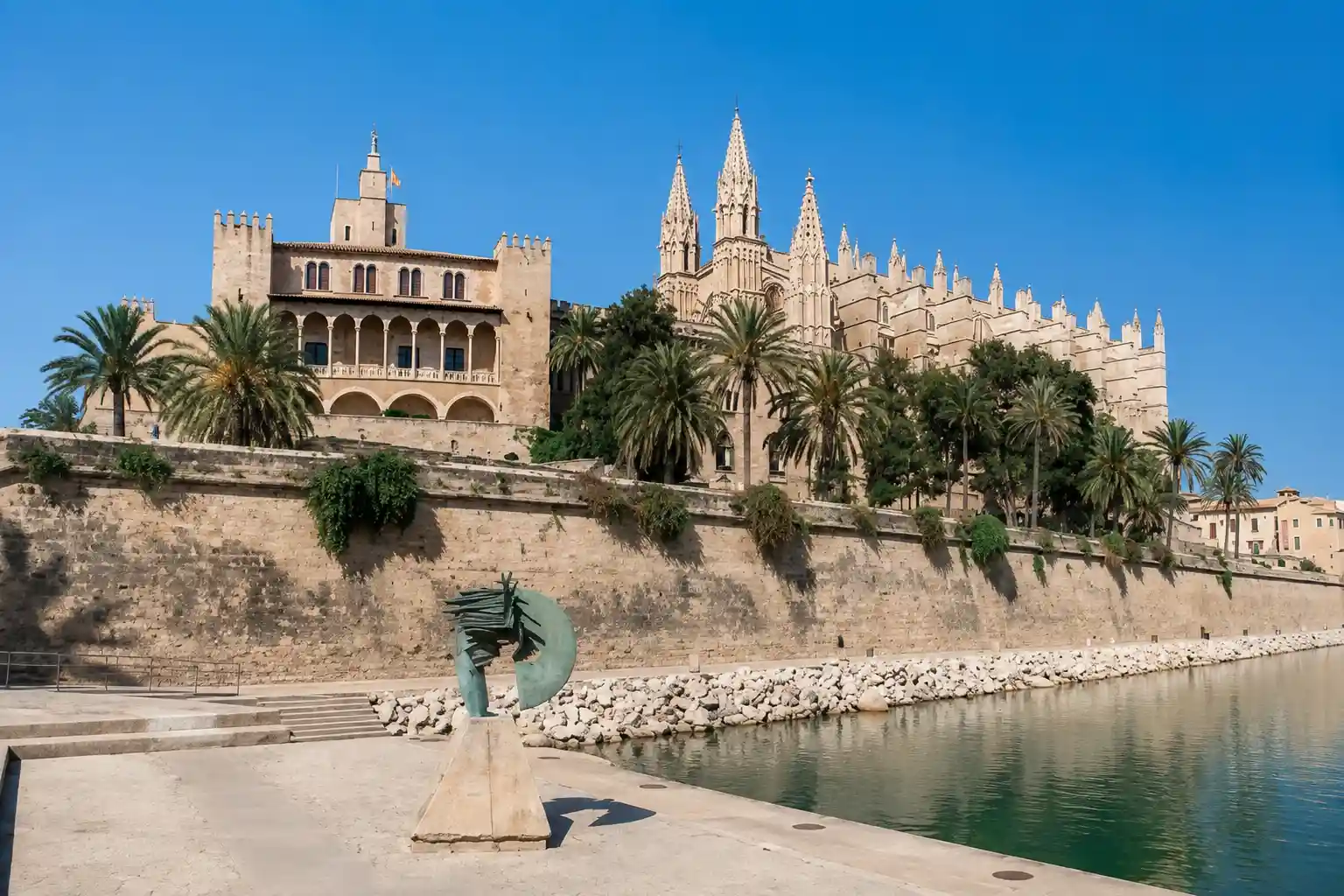
The palace sits in the heart of Palma’s old town, next to the Cathedral and opposite Parc de la Mar. Its location makes it easy to include on a walking route through the Balearic capital’s main monuments.
The building combines remains of the old Moorish fortress with the Gothic architecture of the Crown of Mallorca. The result is a fort-like palace with towers, courtyards, historic halls, a chapel, Islamic-style baths and views over the Bay of Palma.
Although it remains an official residence of the Royal Family during their stays in Mallorca, part of the complex is open to the public as a historic monument.
What is the Royal Palace of La Almudaina?
La Almudaina was originally a Moorish fortress or alcazar built in Mallorca during the Islamic period. The name itself comes from Arabic and is related to the idea of a citadel or fortified enclosure.
After the Christian conquest of Mallorca, the building became the residence of the Kings of Mallorca and later became linked to the Crown of Aragon and the Spanish monarchy. The structure recognisable today largely reflects the transformations carried out during the 13th and 14th centuries.
The palace is one of the places that best explains Palma’s historical evolution: first as an Islamic power centre, then as a medieval royal residence and, today, as the official residence of the head of state in the Balearic Islands.
History in brief
- Islamic period: the site is used as a defensive enclosure and centre of power of the city.
- Christian conquest: the alcazar passes to the Christian Crown after the conquest of Mallorca.
- 14th century: major reforms are carried out and much of the palace’s Gothic image takes shape.
- Modern Age: the building keeps administrative, institutional and ceremonial functions.
- Contemporary period: La Almudaina becomes part of the Royal Sites managed by Patrimonio Nacional.
- 2026: a full renovation ends, reorganising the route and adding new visitable rooms, including the Queen’s Palace.
What to see at La Almudaina
The visit is not just about walking through a decorated palace. The main interest lies in seeing how Moorish, medieval and palatial traces coexist in the same building.
Court of Honour
The Court of Honour, also known as the King’s Courtyard, is one of the most recognisable spaces of the monument. It works as the palace’s hub and gives a first impression of its historic, ceremonial character. From here you can reach different rooms and appreciate the defensive volumes of the old fortress.
Chapel of Saint Anne
The Chapel of Saint Anne is one of the most prominent religious elements of La Almudaina. Its Gothic architecture reflects the transformation of the old Moorish enclosure into a Christian royal residence. It is one of the places to look for during the visit, especially for those interested in Mallorcan medieval art.
Arab baths
The Arab baths are among the most popular spaces for visitors. Their presence recalls the Islamic origin of the complex and helps you understand that La Almudaina was not born as a Christian palace but as a fortress tied to Muslim power.
Do not confuse them with the Arab Baths of Palma, another monument in the old town. Use clear link text to avoid confusion.
Gothic Hall
The Gothic Hall is one of the great ceremonial rooms of the palace. Its size, architectural features and ceremonial function help explain La Almudaina’s role as a royal residence.
Queen’s Palace
The big novelty of the 2026 reopening is the addition of the Queen’s Palace to the visitable itinerary. It is a set of rooms on the upper floor that previously were not part of the usual route. This extension gives visitors who had already been before a new reason to return.
Views over Palma and the bay
The palace stands in a privileged position next to the Cathedral and Parc de la Mar. From certain points of the route you get interesting views of the city, the walls and the maritime surroundings.
To enjoy the whole complex, it is worth combining the indoor visit with a walk around the Cathedral, Parc de la Mar and the S’Hort del Rei gardens.
Free admission
Entry is free for certain groups, including:
- Children under 5.
- People with a recognised disability of 33% or more.
- Carers of people with disabilities when their help is essential and accredited.
- Unemployed people who can prove their situation.
- Large families.
- ICOM and ICOMOS members.
- Official tour guides under the established conditions.
- Active teaching staff.
- International Museum Day, 18 May.
- Spain’s National Day, 12 October.
On Wednesdays and Sundays from 15:00 to 19:00, and until 18:00 during the winter period, there is also free entry for EU citizens, residents and holders of residence or work permits in that area, as well as for accredited Ibero-American citizens.
These free tickets are requested at the ticket office and cannot be booked in advance during the free period.
Do you need to book?
Booking is not always mandatory, but it is advisable to buy your ticket online if you visit Palma in high season, on a long weekend or on dates with heavy tourist traffic.
- Choose an available date.
- Reduce the risk of finding the venue full.
- Avoid part of the queue at the ticket office.
- Buy up to 90 days in advance.
- Carry your ticket on your phone using the confirmation code.
The official page says advance purchases can be made online up to the day before, although in some cases tickets can also be bought the same day. Fully free tickets must be requested directly at the ticket office.
Practical advice
- Standard visit on a weekday: you can try buying at the ticket office.
- July, August and long weekends: better to book online.
- Free visit on Wednesday or Sunday: go to the ticket office with the necessary documents.
- Families or groups: book further in advance.
- Guided tour: check there are spaces before you go.
You do not need to print your ticket: just show the confirmation email or QR code from your phone.
Guided tours and audio guide
Patrimonio Nacional offers guided tours by specialised staff. The official information published for 2026 lists these times:
- Spanish: Tuesday to Sunday at 10:30 and 13:30.
- English: Tuesday to Sunday at 12:00.
- German: Tuesday to Friday at 12:30.
Approximate duration: 1 hour.
A guided tour is a good option if you want to better understand the link between the Moorish fortress, the medieval residence and the current palace.
There is also an interactive audio guide available for rent and a digital version to use on your phone. For the digital audio guide, bring enough battery and your own headphones. If you buy a guided tour, you do not need to rent the audio guide too.
How long does the visit take?
For a normal visit, allow between 60 and 90 minutes.
| Visit type | Recommended time |
|---|---|
| Quick tour | 45–60 minutes |
| Normal visit | 60–90 minutes |
| With audio guide and detailed reading | 90–120 minutes |
| Official guided tour | About 1 hour |
Add between 30 and 60 minutes to see the outside, take photos and walk around the Cathedral and Parc de la Mar.
A good plan is to set aside two hours for La Almudaina and then continue on foot to Mallorca Cathedral, the Bishop’s Palace, the old town’s Arab baths and the streets of the old quarter.
Is La Almudaina worth visiting?
Yes, especially if it is your first visit to Palma. La Almudaina is worth it for five reasons:
- It is next to the Cathedral, so it is very easy to include on a route through the centre.
- It brings together Islamic, medieval and royal history in a single building.
- It has unique spaces such as the Arab baths, the Court of Honour and the Gothic Hall.
- The 2026 renovation has extended the route with new rooms.
- It is a relatively short visit that fits well with other attractions in Palma.
It may be less interesting if you are looking for a painting museum with large collections. La Almudaina is above all a historic and architectural monument, not a conventional museum.
Who is it especially recommended for?
- People interested in the history of Mallorca.
- Travellers visiting Palma for the first time.
- Families looking for a cultural activity of moderate length.
- Lovers of medieval architecture.
- Visitors to Mallorca Cathedral.
- People who want to see an official residence of the Spanish monarchy.
Accessibility and rules
The Royal Palace has access for people with disabilities. To find out which specific areas are adapted, check beforehand with Patrimonio Nacional, as the historic structure may limit access to certain spaces.
Photography without flash is allowed for personal use, except in areas where otherwise indicated.
You are not allowed to use:
- Tripods.
- Selfie sticks.
- Similar items that could disturb visitors or put the pieces and others at risk.
You must also respect the privacy of visitors and site staff.
Tips for planning your visit
- Book online if you travel in summer or on a busy weekend.
- Avoid arriving at the last minute because access ends one hour before closing.
- Combine La Almudaina with the Cathedral, as they are almost next to each other.
- Check the days of official events, especially in summer.
- Bring ID if you plan to use a reduced or free rate.
- If you want a full historical explanation, choose the guided tour.
- If you visit on your own, allow at least an hour so you do not have to rush.
- After the visit, stroll through S’Hort del Rei and Parc de la Mar.
- Do not confuse the palace’s Arab baths with the Arab Baths of Palma.
- Check prices and opening hours on the official website before publishing a final update.
Recommended half-day route
A simple route through Palma’s monumental centre could follow this order:
- Mallorca Cathedral.
- Royal Palace of La Almudaina.
- S’Hort del Rei gardens.
- Bishop’s Palace and old-town streets.
- Arab Baths of Palma.
- Parc de la Mar.
- Seafront or La Lonja area.
La Almudaina can be visited at the start or the end of the route. To avoid the heat, it is usually best to do the interiors first and leave the outdoor walk for the end.